
Apply to your system: Schools
This page applies the System Picture Framework to one shared vision in a school setting: preventing sexual harm and violence, and responding well when it happens.
The questions below are for school leaders, designated safeguarding leads, governors and staff to work through together, ideally alongside children and young people, and parents and carers. They aren't a checklist. They're a way of seeing the whole picture: what's already in place, where the gaps are, and what you're aspiring for it to be. For each element, there are questions to ask and some signs of how you'd know.
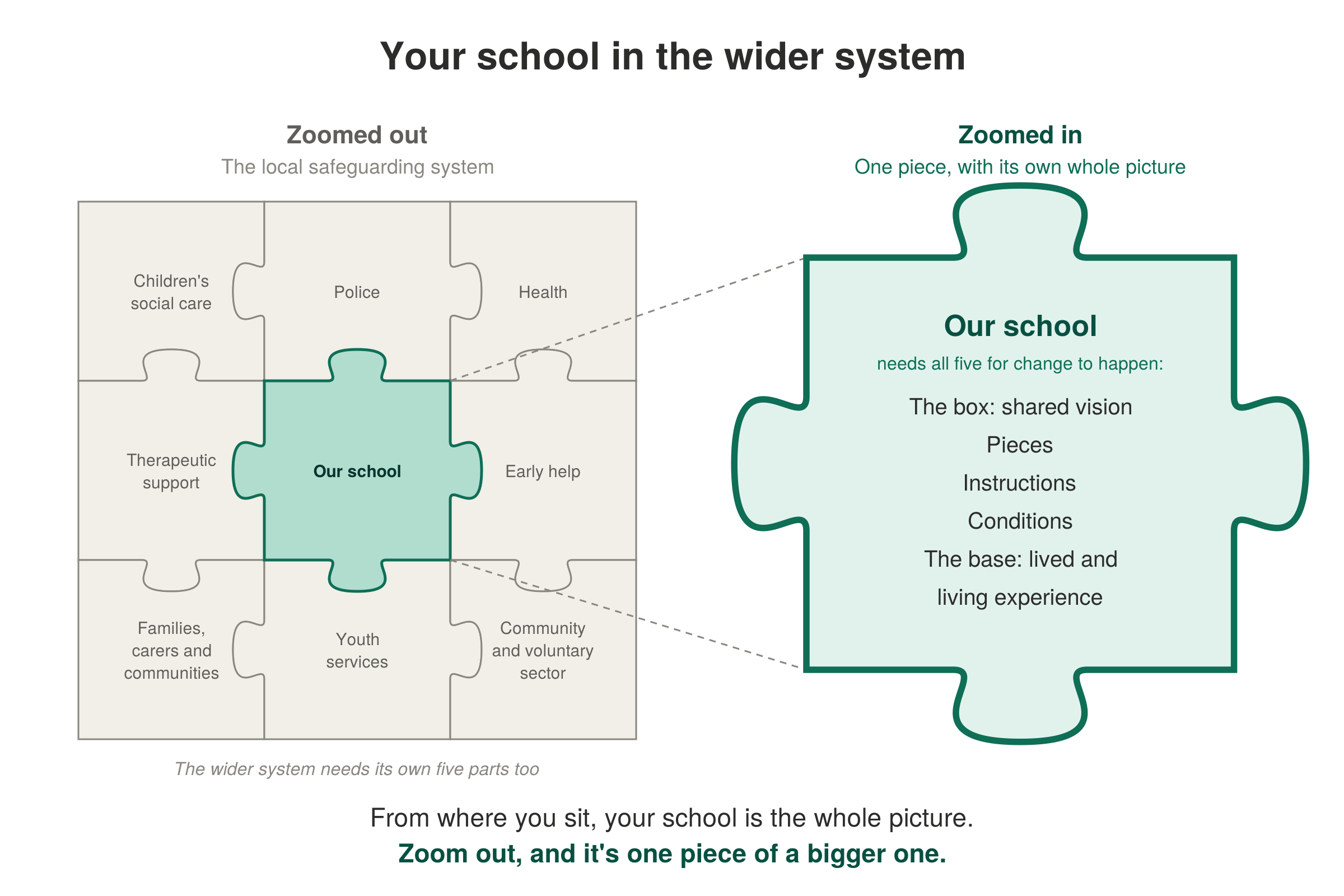
Your school needs all five parts in place for change to happen. But your school is also one piece of a bigger picture. The pieces section below asks about your tabs and blanks: how you reach out to others, and what you need from them. That's how your school fits with everyone else's.
The box – shared vision
The picture everyone is building towards. Without it, everyone builds something slightly different.
Questions to ask
What is our shared vision? Does it include both preventing sexual harm and responding well when it happens?
Who developed it? Was it co-created with children and young people, parents and carers, and staff, or written by a few and handed down?
How does our vision connect with the wider system: children's social care, the police, therapeutic support, and partners working with families?
Do parents and carers see themselves as part of this vision, or as people who are told about it?
How you'd know
Staff, pupils and parents can describe the vision in their own words.
Children and young people can point to how they helped shape it.
The vision is referenced in decisions, not just displayed on a wall.
The pieces – activities and services
The things we do: lessons, assemblies, campaigns, interventions, restrictions. Each piece has a middle, tabs, blanks and edges, and the pieces need to be coordinated, joined up, layered and complementary.
Questions to ask
The middle: What do we confidently do and deliver? How do we know it's making a difference?
Tabs: How do we reach out to others? Who attends multi-agency meetings, such as Risk Outside the Home, and links in with missing and child sexual exploitation work? What do we bring to them?
Blanks: What do we need from others? How do intelligence, data, updates on new trends and changes to teams and services reach us?
Edges: Where do our roles and responsibilities start and stop? Are those boundaries clear to staff, families and partners?
Forced pieces: Are we being asked to step into spaces that aren't ours, such as a targeted intervention for a child displaying problematic sexual behaviour? Do staff have the training and support to do this safely, or who should we be referring to instead?
Which of our pieces disrupt harm, which educate, and which build the how: the skills and confidence to act?
Were any of our pieces co-designed with children and young people, or with parents and carers?
How do our pieces connect with support for children who have been harmed, and for children displaying harmful sexual behaviour?
How you'd know
You can map your pieces and see how they layer and build on each other, rather than standing alone.
Learning is followed up, not delivered as a one-off.
Staff know when to hold a piece and when to refer on.
The instructions – policies and procedures
How the system is meant to work: governance, recording, referral pathways, information sharing, decision making and review.
Questions to ask
Are our procedures for recording safeguarding incidents and actions clear, and do all staff follow them consistently?
Do we know when and how to make onward referrals to the wider safeguarding system?
What happens straight after a report of child-on-child sexual harm? Is there risk assessment and safety planning for both the child who has been harmed and the child who has caused harm?
Does our behaviour policy join up with safeguarding, so sexual harassment is never dismissed as "banter"?
Do staff know exactly what to do, and what not to do, when nudes or images are shared?
Do children and young people understand what will happen if they tell someone, both if they're experiencing harm and as a consequence of unhealthy behaviour? Has that been explained in a way they understand and trust?
How do governors oversee this? Is there a named safeguarding governor? Do governors receive regular reports on safeguarding trends, and review whether the whole school approach is working?
How you'd know
Records show what happened, what was done, and what followed.
Staff can describe the route for a concern without looking it up.
Young people can tell you what happens when someone shares a worry.
Governors can describe the trends in your safeguarding data and what's changed as a result.
The conditions – culture, confidence and relationships
What makes it possible for everything else to work: trust, relationships, shared language and psychological safety.
Questions to ask
Do children and young people feel confident they'll be listened to, believed, and know what will happen next?
Do staff feel confident to recognise unhealthy behaviours, respond appropriately and manage disclosures?
Is it okay here to say "I'm not sure", "I don't know" or "Can you help me understand?" How do we support staff for whom this isn't their area of expertise?
Are we trauma-informed, both for children who have experienced sexual abuse and for children displaying harmful sexual behaviour? Do we try to understand what's driving a behaviour, and what need a child is seeking to meet?
How do staff interact with children and young people, and with each other? Do those relationships model respect?
Where does responsibility sit? Do our responses ever blame the child who has been harmed?
Is our practice informed by the evidence on intersectionality, for example recognising the impact of systemic and institutional racism? Which children need additional safeguards, such as children who receive personal care?
Do we have the capacity, skills and curiosity to learn from our safeguarding data, and does that learning change what we do?
Do governors feel confident and informed enough to ask curious questions and offer kind challenge, rather than just receiving reports?
How you'd know
Children and young people tell us they feel safe to talk with school-based staff about what's happening in their lives.
Staff ask for help without fear of judgement.
Disclosures are met calmly and consistently.
Trends in your data lead to changes in your pieces.
The base – lived and living experience
The foundation everything is built on, not a stakeholder to consult after the fact.
Questions to ask
How do we seek the voices of children and young people? Are they involved in development, delivery and decision making, across the vision, pieces, instructions and conditions?
What are young people telling us about the issues that shape their lives right now, including online?
Are we building critical analysis skills, so young people can question what they see from peers and online?
Do young people have the confidence and language to say no in front of friends, and to receive a no without mocking others?
Knowing that young people often tell their friends first, are we clear that it's not a child's job to fix it, but to tell a trusted adult?
Do we recognise that not every child sees healthy relationships role modelled at home?
How do we know how our conditions are experienced by children and young people, not just how we intend them?
How you'd know
Young people can point to something that changed because of what they said.
Co-created campaigns or resources are visible across the school.
Young people say they feel heard.
Next steps
You might find some elements are strong and others are missing altogether. That's the point: seeing the whole picture shows you where to focus. A useful next step is to ask, for each element, where you are now and where you're aspiring to be.
For the thinking behind this page, read my blog on sexual violence in schools. If you'd like support to work through this with your school, please get in touch.
More examples are on their way, from different settings and roles. If you'd like to explore what the System Picture Framework could look like in your organisation or partnership, I'd love to hear from you.